

Beyond the extortionate ticket prices lies a far more frightening cost
With Thomas Tuchel set to announce his England squad tomorrow and the Premier League coming to an end at the weekend, football fans’ attention will soon be gripped by the upcoming World Cup tournament in North America this summer.
The tournament has long been mired in controversy. Though kicking off in just three weeks, qualifying Iran’s participation remains diplomatically fraught given its tensions with the host nation, the United States.
Ticket costs have also come under immense scrutiny. The cheapest ticket for the final is priced at over £3,000, and even Trump admitted that he wouldn’t pay the £1,000 asking price for the US’s opener against Paraguay and he hardly strikes me as a bloke that follows Martin Lewis’ money-saving tips.
But simmering beneath the overt geopolitics and eye-watering lies a far more consequential problem: the World Cup’s environmental bill.
This year’s tournament will operate at a scale never seen before, with a record 48 participants, 104 matches and being played across a whole continent for the very first time, and undoubtedly the scale of competition will translate to the scale of environmental damage.
Estimates suggest that more than 9m tonnes of carbon dioxide will be produced - the equivalent to nearly 6.5 million average British cars being driven around for an entire year and nearly double those at the most environmentally damaging World Cup to date (second place being 5.25 million tonnes at Qatar 2022).
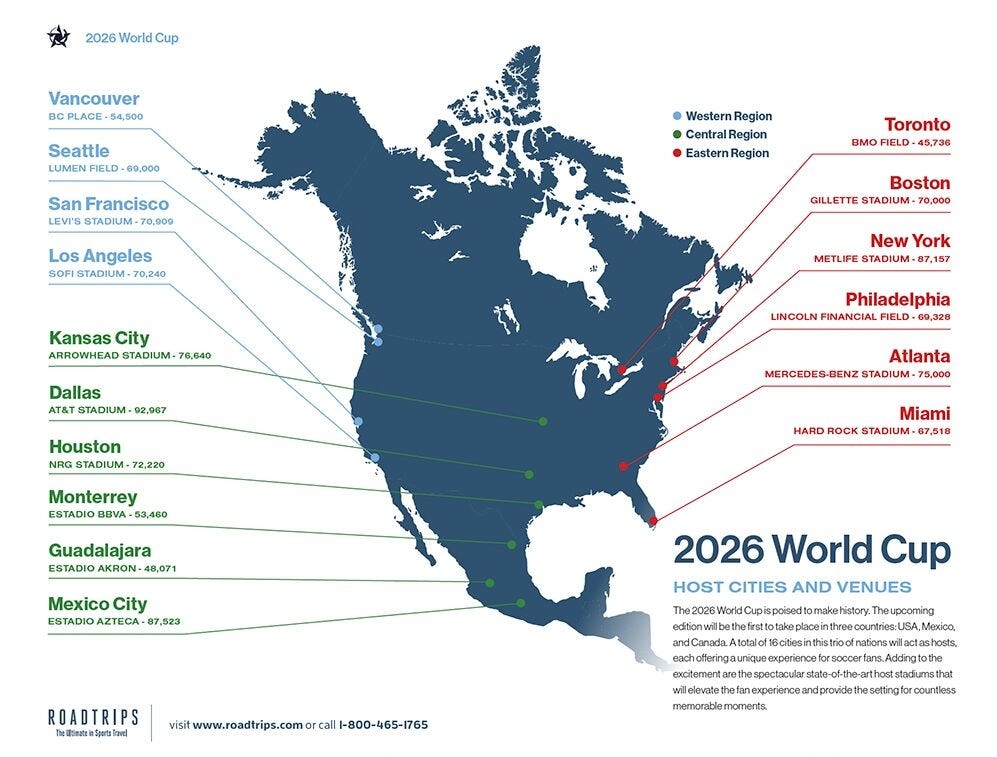
The main factor driving the spike in emissions is air travel. Spanning from Vancouver to Mexico City, players and fans alike will travel vastly further distances than ever before to attend matches. With a lack of a high-speed rail network in place, most will be forced into the far more environmentally damaging option of flying between cities.
Air transport alone is projected to account for 7.72 million tonnes of CO2e, more than four times the size of emissions seen in a typical 2010-2022 tournament. While at the 2022 World Cup in Qatar, stadiums were located relatively close together, linked by metro and buses, in this 2026 iteration, players and fans are set to travel extreme distances.
Bosnia and Herzegovina will have to travel more than 5,000km from Toronto to Los Angeles to Seattle. Algeria will log around 4,800km in air miles, journeying from Kansas City to San Francisco and back.

Some will argue this is the price for making football more global and inclusive. But that stance masks the real issue: the sustained, flagrant process of greenwashing by FIFA.
Ahead of the last World Cup, FIFA President Gianni Infantino produced a YouTube video imploring football fans “to raise FIFA’s green card for the planet”. The card in question looks like it was designed by a primary schooler. Coupled with a video that was just one minute and eight seconds long (doesn’t he know it’s TikTok that you have to reach the minute mark for monetisation?), it was hardly befitting of his call for action and his aim to make the tournament carbon neutral.
The term that comes to mind is half-baked, which I wouldn’t be surprised Infantino and the other buffoons over at FIFA were when they came up with it.
In what came as a surprise to absolutely no one, despite Infantino’s oh-so-earnest plea, the Qatar 2022 World Cup was not carbon neutral. The tournament used an energy-intensive desalination system to purify water and the grass seeds for the pitches were flown in from North America on climate-controlled aeroplanes.
Infantino’s message fell pathetically flat. It was essentially the equivalent of telling people you’re doing Dry January and then proceeding to go out the same evening and neck seven pints.
If that was the case in 2022, then 2026 looks set to be passed out in the corner after going on a seven-day-long bender. Scholar Tim Walter argues that the upcoming tournament could lead to the premature deaths of up to 70,000 people, making it the deadliest sporting event in history.
None of this was inevitable. FIFA chose to increase the number of participating teams to 48 from 32. FIFA chose to spread it across an entire continent. FIFA chose spectacle over sustainability.
You would have thought that some consideration of cause and effect went into the decision. But beyond rhetoric, and a whopping 68 seconds of it at that, it has chosen to do almost nothing meaningful to mitigate the consequences.
If Qatar 2022 was the canary in the coal mine, the bird has long since perished and we’re still digging around.